Featured post

Press Release: Release of second edition (digital) of ‘Less than Gay’ – A Citizens’ Report on the status of Homosexuality in India

    The AIDS Bhedbhav Virodhi Andolan (ABVA) is releasing the second edition of ‘ Less than Gay ’ – A Citizens’ Report on the status of Homo...

Sunday, 5 August 2018

Rainbow at the end of the road: Queer resistance to Section 377

Rainbow at the end of the road: 

Queer resistance to Section 377

A brief history of queer resistance to Section 377 of the Indian Penal Code, 

from the silence and stigma of the nineties to the assertion today.

Written by Dipanita Nath | Updated: August 5, 2018 8:27:42 am

LGBTQ in india, queer resistance, section 377, gay, bisexual, transgender, lesbian, LGBTQI+ rights, LGBTQI+ community, LGBTQ, indian express, indian express news
X
Embracing difference: The internet has become a safe space for the community. (Illustration: Suvajit Dey)
The boy who calls himself Cherry is wearing a fitted blouse, blue-and-cream striped pants that end above his ankles, and white shoes sprinkled with glitter. His hair is immaculately brushed. He smells nice. After this party in a five-star hotel in south Delhi gets over, he will look for a washroom to change back into a black T-shirt and jeans — as if, he has been to a regular birthday party, just as he has told his mother.
He will also clean up carefully. “Once I had a love bite and my mother noticed it. She thinks it was a girl,” he says, scrolling through one of his two Facebook profile pages. On the first, he checked in at a nearby mall an hour ago. On the other, he is a poet and gay. “When I look at this page on my phone, my eyes are all the time on the door. Koi aa gaya toh? Kisi ne dekh liya toh?” says the Delhi University student, who reads crime novels and is a fan of Virat Kohli.

He is just looking for social acceptance, he adds, and his own circle. “I want to have a place where I can talk freely to my friends and just be myself,” he adds. What has he to say about Section 377 of the Indian Penal Code (IPC)? “It’s the 21st century, right? We shouldn’t even be talking about 377. Shouldn’t they have ended it in the last century?” he asks.
They did try. At a tea stall in Connaught Place, Cherry might meet members of the AIDS Bhedbhav Vidroh Andolan (ABVA), now a group of elderly people who used to be idealist, Left-leaning youth from the medical, legal, academic, human rights and social work fields. In April 1994, ABVA had filed a 75,000-word petition in the Delhi High Court asking for Section 377, which criminalises homosexuality, to be struck down. Advocate Shobha Aggarwal had stood before a judge, who had asked, “So, are you in favour of free sex?” One of the lawyers for ABVA shot back, “My Lord, I am in favour of safe sex.” In 2001, the case was dismissed. Aggarwal, who was 31 then, says, “Apart from the attitude of the judges, there was no member of the gay community who came forward.”
A human rights activist remembers it as a time of fear. “Those of us who were out were of two kinds. Either we were front-line, working-class trans people who had to be out because chhupney ki koi jagah hi nahi thi (there was no place to hide). Or, we had the economic capital to say, kucch ho bhi jayega toh nikal jayenge (we’ll survive even if someone gets to know),” he says. He had come out to his mother, but she had asked him not to mention it publicly. She was worried about the consequences.
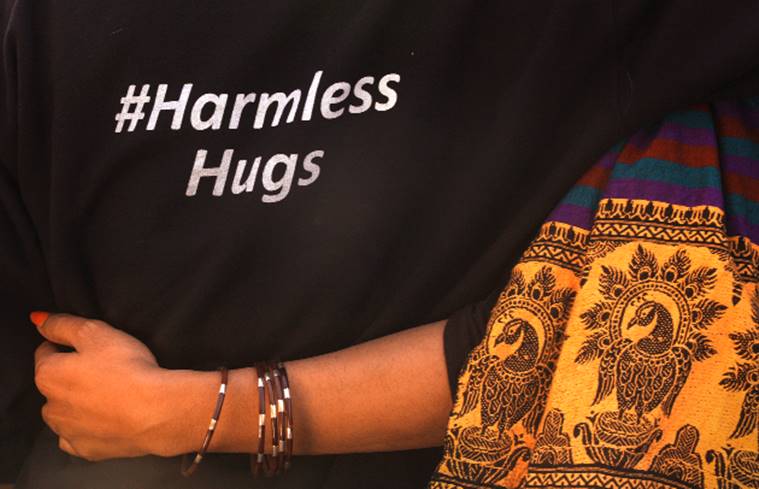
Members of the group Harmless Hugs.
ABVA, which used to meet in the India Coffee House on Wednesdays, was taunted as the G Group, after a Hindi expletive for sodomiser. One of the triggers for the ABVA petition had been the arrest in 1992 of a dozen men at Central Park, a cruising site for gays in Delhi’s Connaught Place since before Independence. Gay people were easy targets of police extortion, blackmail and sexual favours. The arrests had led to the first public protest at the park — by the 18-member ABVA — followed by a large demonstration at the Delhi Police headquarters.
They were also up against the belief that there were no homosexuals in India. In 1994, when a survey pointed out that more than two-thirds of inmates of Tihar Jail indulged in homosexual activities, former Delhi IG (prisons) Kiran Bedi had said, “My prisoners are hurt by the allegations.” In 1998, right-wing groups had announced “there are no lesbians in India” to justify attacks on the film, Fire. “Lawyers could not even speak the word, homosexual, forget about giving credence to gay people. Today, people say LGBT as if it’s the most normal thing, like kela or santra,” says the activist.
Last month, a five-judge bench of the Supreme Court of India heard a batch of new petitions appealing for Section 377 to be read or struck down. Lawyer Menaka Guruswamy, who represents an LGBTQI community from the IITs, had said, “How strongly must we love knowing we are un-convicted felons under Section 377? My Lords, this is love that must be constitutionally recognised, and not just sexual acts.”
Aggarwal was surprised to see the crowd that turned up for the hearings this July — there was barely space to stand in Court Number One. In the late ’90s, there were few people in the Delhi High Court curious about the arguments against Section 377.

Out of the Bottle

The year that ABVA’s petition was dismissed, another was filed in the Delhi High Court, this time for Section 377 to be read down to exclude adult consensual acts. Aditya Bondyopadhyay, who wrote the petition as part of Lawyers Collective, is preparing to move to Puducherry, where he and his partner have found a place by the sea. “I can afford to relax now. I never thought that in my lifetime I would see people, who identify as gay, on the streets and the courts in our favour,” he says.
When he identified as homosexual in the 1990s, there were only about six openly gay men out in India. Among them were Ashok Row Kavi, Owais Khan, Arif Jafar and Pawan Dhall. “If a religious fanatic had decided he wanted a gay-mukt Bharat, he would only have had to travel to six cities and kill six people,” says Bondyopadhyay.
When Bondyopadhyay was a 19-year-old student in Kolkata, his close friend Sujoy committed suicide. “He was in the Dhakuria Lake area with a male friend. He was found by two policemen. The cops took whatever money he had but they also took his phone number and his address,” says Bondyopadhyay. The police began to visit Sujoy’s house in the morning when his parents were out at work. “They threatened to tell his family. At first, he gave the cops all his pocket money. Then he started stealing money and jewellery from the house, but the blackmail continued. We told him, ‘Tell your mother you have to go away for studies to Delhi. Just leave Kolkata’. It didn’t help. One day, Sujoy couldn’t take it any more and drowned himself in the Dhakuria lake,” he says.
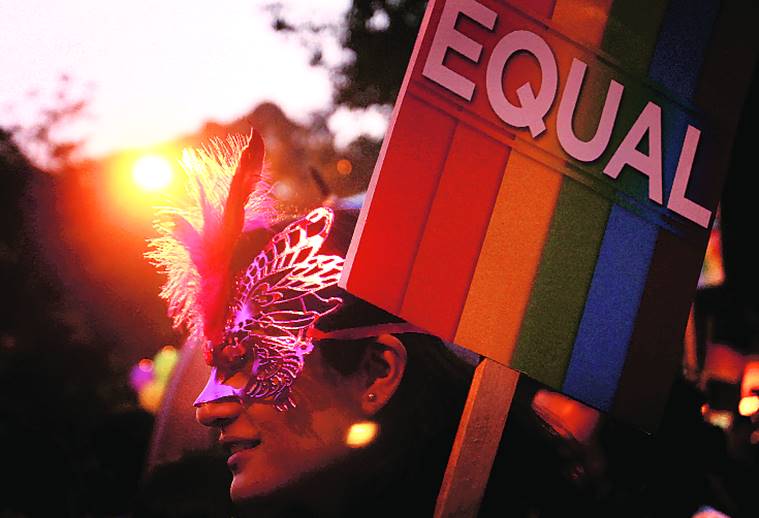
Time’s up: A woman at a pride march, held in Delhi a month before the 2013 Supreme Court judgement recriminalising homosexuality.
When Bondyopadhyay thought about it, he came to the conclusion that his friend could be blackmailed because he had something to hide. “That’s when I decided I will never hide. I will never have a secret with which anybody can blackmail me. Probably that is why I am out and loud about my own sexuality,” he says.
While they were drafting the petition for Naz Foundation — which would ultimately lead the Delhi HC to read down Section 377 in 2009 — there were arguments about what line or ground to take. “We had to make the health argument. We couldn’t just go to the court and say, ‘We are queer and need to be given our rights’. We had to cushion it with HIV,” he says.
The office of Naz Foundation, an NGO that works on HIV/AIDS and sexual health, is situated in a residential area in south Delhi. It is here that Anjali Gopalan had “braced for a long battle”. Around the turn of the millennium, a couple had brought their 21-year-old son to her, hoping she would drive “sense” into him. “I explained to them that he was gay and forcing him to get married was not the solution,” she says. She didn’t hear from them again. The boy did come back. He had been getting shock treatment at a hospital in Delhi to make him straight, he told her. Gopalan went to the Human Rights Commission but they didn’t register the case as “homosexuality was a crime”.
The Naz Petition wasn’t only a legal effort. “We had to change mindsets. I realised that my involvement in the court was not that important because there were all these good lawyers willing to fight. I would work with organisations to increase visibility, decrease negative perception and make us acceptable. The media, especially, had to be on our side. We trained activists to go to TV studios and talk. We had huge consultations over Section 377 when over 100 different groups such as Gay Bombay, Bharosa, Adhikaar from all over India came and strategised,” Bondyopadhyay says. The sessions were held in Delhi, Kolkata, Bengaluru, Hyderabad and Mumbai in 2001-2002.
The groups decided that it was no longer enough to be quietly distributing condoms and hoping the police won’t know. “No longer under the radar, the community had to be out there and brazenly living our lives,” he says. The gay community continues to maintain linkages with the media, women’s groups, liberal, left-leaning students unions, workers’ groups that are left of centre and religious minority groups.
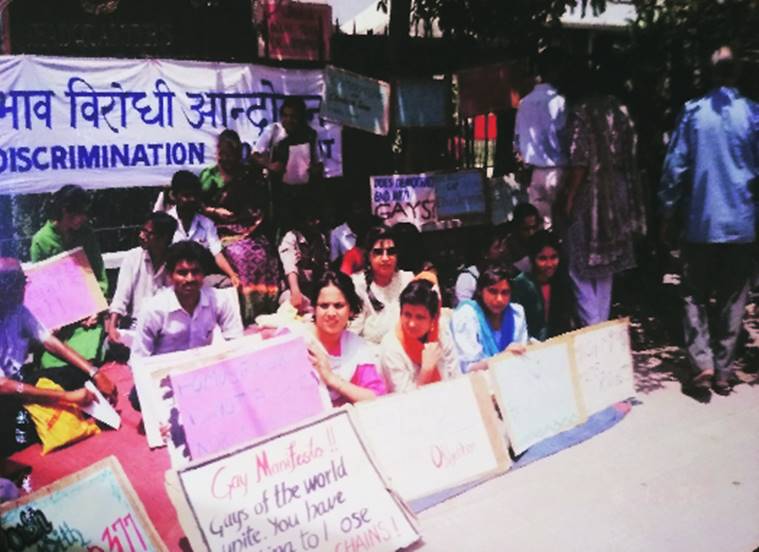
ABVA at the first major protest in India condemning police atrocities on gay people, at the Delhi Police Headquarters. (Source: ABVA)
When the organisation, Alliance India, received $40 million in 2004-05 from a global fund to fight AIDS, tuberculosis and malaria, Bondyopadhyay says, “One of the things we insisted on was the formation of almost 400 community-based support groups in small towns of India”. “We wanted to spread the movement to small-town India, away from the metros, and politicise the people to such an extent that even when the funds dry up, the genie never goes back into the bottle,” he says.
He spent a lot of time to mobilise the international human rights crowd to keep the pressure on the Indian government. “For five years, I spent three months in Geneva when the United Nations Committee on Human Rights met. I was the first Indian to testify before the committee against India supporting and sponsoring oppression of sexual minorities,” he says.
Not everybody agreed with the strategies. One of the first points of difference was the language of the movement. Vernacular or English? “Identities were always there and terms existed. When denied, homosexuality had gone underground and created a sub-language of its own,” he says. Should these indigenous terms — which are spoken by the queer community from Kandahar in Afghanistan to Chittagong in Bangladesh — be replaced by the Western vocabulary of “gay”, “lesbian”, “queer” and “LGBT”? Where should the case to read out the law be filed — Mumbai or Delhi? Or should there be more than one? But by the time the Lawyers Collective placed Naz Foundation’s petition before Delhi High Court, these questions didn’t matter. The entire queer community mobilised. Subsequently, every time there was a setback, the community came together.

The Door is Half Open

Balbir Krishan, a BA student in a west UP village in 1994, had made some sketches based on Ajanta’s semi-nude drawings that got some older people so angry they told him that he was “doing dirty work”. “In my childhood, I faced sexual abuse. How many times and how many men raped me, I can’t count. I learned that I have to hide many things from my family and society. So I destroyed some sketches and hid the others,” he says. By 1999, when he decided to become a professional artist, queer artistes were only tentatively coming out and finding the doors half open.
A queer performer in Kolkata, Sudarshan Chakraborty, made a dance drama, The Alien Flower, about a gay man who is forced to seek psychiatric help, in 1998. “I received a threat call from the husband of a famous dancer even as the audience queue stretched from the front door of the hall to the road,” he says.
As a youngster, Krishan had fought with his family, friends and, more than anyone, with himself about his sexuality. In 1996, during his MA, he was on the brink. “I was done with this life and society,” he says. He lay down on a railway track in Agra. “I survived but I lost both my legs. Then the fight became harder but this time my art saved me,” he says.
In 2007, the fledgling artist moved to New Delhi from his village with “this big hope that I will find more opportunity and freedom.” “Very soon, I found out that my whole identity was an issue in Delhi’s art world. In three years, I did everything to find a single opportunity to exhibit or sell my work but found none. There were only rejections everywhere. Galleries, art curators and artists liked my work but wouldn’t agree to exhibit. Many of them told me to change my subject but I couldn’t compromise,” he says. He moved back to his village in 2010.
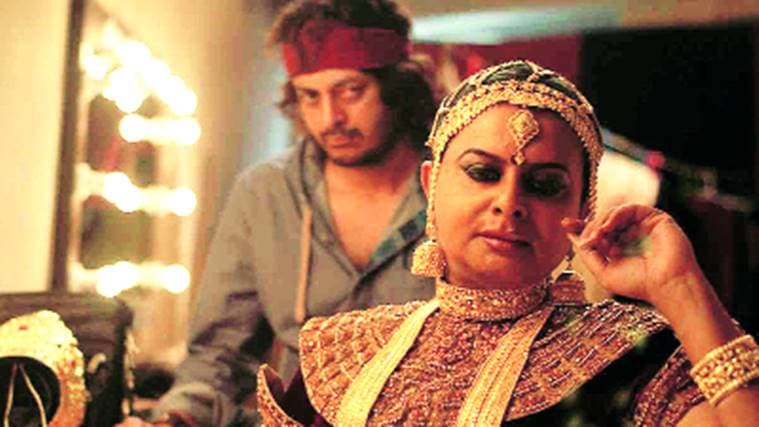
A still from filmmaker Rituparno Ghosh’s Chitrangada.
In the meantime, queer writing, poetry slams and films had begun to explode across India. Actor-filmmaker Rituparno Ghosh’s oeuvre took a sudden turn, as he played gay protagonists in Kaushik Ganguly’s Arekti Premer Golpo (2010) and Sanjoy Nag’s Memories in March (2010). He was paired opposite Jishu Sengupta in a gay love story, Chitrangada (2012). He shaved his head and began to wear androgynous clothing. In Mumbai, another filmmaker, Sridhar Rangayan, was openly gay.
But, in 2012, gay photographer Sunil Gupta’s show, “Sun City and Other Stories” was taken down at the Alliance Francaise de Delhi though the opening was attended by over 100 people, including a cross-section of important personalities. According to an official statement of Alliance Francaise, “It is pertinent to point out that, even though the police had publicly stated that the content of the exhibition was not objectionable or unlawful, their verbal direction to the Alliance was to the contrary and was the governing factor in the decision to cancel the show.”
After he got a job, Krishan decided to organise his show at the Lalit Kala Akademi in 2012. “Out Here and Now” opened in Lalit Kala Akademi, a government venue in the heart of Delhi’s art district. “I was surprised that the opening was successful. A large number of people came to attend the show,” he says. A few days later, the exhibition was attacked by an unidentified man. “He destroyed one of my works, threw me on the floor and kicked me. I was unable to help, given my disability. I was shocked and scared that someone could do this.”
One day after the attack, Krishna’s show moved to Triveni Kala Sangam. “This time, the art world, LGBTQI community and the media turned out in huge support,” says Krishna, who now lives in the US. He had come out in 2012, when he decided to marry his partner, Michael Giangrasso, a teacher. “When people found out about my marriage, everyone got mad — my family, village and the khap panchayat. My life was in danger and, in 2013, I was forced to leave. After that I never returned to my village,” says Krishan, who lives with Michael in the US.
A work from Balbir Krishan’s ‘Out Here And Now’.
In June, as the countdown began to the hearings in the Supreme Court, a Delhi-based human rights group, Engendered, held a show at the American Centre, titled “Me We”, which featured only queer artists, 25 of them. “Art is about permanent resistance because it is work that stays. Dance, theatre seem innocuous but are strong mobilising forces,” says Myna Mukherjee, cultural curator and founder of Engendered.

Long March to Freedom

In 1999, Kolkata had hosted the first “pride” march and, in 2008, it arrived in Delhi, to be followed by Mumbai six months later. “We needed to be more visible. Let people see us in fancy masks and realise that LGBT is not about how to f***, where and why, but it is also about a lifestyle choice and culture, joy, celebration,” says Bondyopadhyay, who has been one of the organisers. Dressed in feathers and frills, holding up placards and giant flags, the queer community came out in rainbow colours. In 2017-18, there were 19 pride marches “including in towns such as Bhabua and Kushingar”. A pride was held two days before the Delhi High Court announced a pathbreaking verdict in 2009.
When the Supreme Court recriminalised homosexuality in 2013, the Delhi queer pride committee quietly changed its slogan to “No going back”. “I changed my Facebook picture to show a slash through the number 377. I will remove it only when homosexuality is decriminalised,” says Manish Sharma, standing on the doorway of a party he has organised. More than 200 male couples have crowded the bar and the mirrored ceiling reflects them dancing as the DJ turns up the volume on Aane do, aane do / Dil mein aa jaane do. “After 2009, the number of people at my parties went up to 500 or 600. I had to arrange for bigger venues,” says Sharma, who has been organising gay parties since 2008. “Then, in 2013, the Supreme Court verdict forced people back into the closet. I am out and I don’t care who knows. Most of the boys dancing here have to hide their real selves at home or in their workplaces. There is no other choice,” he says. But the music is pumping the adrenaline, Kehdo ghabrahat ko / Bye, bye, bye, bye, bye-bye. Suddenly, the DJ lowers the volume and, from the silent, dark dance floor, a chorus of voices rise, “Love you zindagi”.

Wednesday, 1 August 2018

Doctors and activists clash over AIDS in Asia


by 

PHYLLIDA BROWN in 

Activists in Asia have begun the long campaign to enlighten their governments,
doctors and scientists about the politics of AIDS. Last week’s Second International
Congress on AIDS in Asia and the Pacific, held in Delhi, brought little
new technical knowledge on the disease, but it provided historic first encounters
in the region between politicians and people with HIV, and between doctors
and activists struggling to end discriminatory practices.
In scenes reminiscent of the American AIDS conferences of the eighties,
doctors watched perplexed as activist groups protested against testing prostitutes
without their consent and the refusal of hospitals to admit patients with
HIV. By the end of the conference, senior Indian medical officials had been
stung into a public response, indicating that some sort of dialogue may
finally have begun.
The conference was widely derided as an expensive jamboree, remote from
the needs of people affected by HIV. Delegates from China and the Philippines
complained that the focus was too narrowly on India, while many felt the
voice of the Australians had been too loud. But P. R. Dasgupta, head of
India’s National AIDS Control Organisation, told New Scientist it had been
‘very, very valuable’ for overturning some ‘insular perceptions’ of the
disease in India.
The week saw the first meetings of a group of Asians representing gay
organisations from India, Malaysia, Indonesia and other countries in Southeast
Asia. Initially, gay groups were angry that they had been allotted only
one session at the conference, and this right at the end when many delegates
would be leaving. But in the end they upstaged the rest of the con-ference,
gaining front-page coverage in The Times of India.
The umbrella group wants to increase the visibility in Asia of gay men,
lesbians and other sexual minorities such as India’s hijras, or eunuchs.
Ashok Row Kavi, the chairman of the group, from a Bombay-based gay newspaper
called Bombay Dost, said that the WHO and other bodies had wrongly assumed
that homosexuality was virtually nonexistent in Asia. This assumption was
affecting epidemiological models of the spread of HIV and meant that funds
and education were being channelled exclusively towards organisations working
with female prostitutes, said Kavi.
No one knows how common homo-sexuality is in Asia. In most of the region’s
countries, homosexuality is illegal but the few gay men who dare to come
out say it is widespread. The majority of men who have sex with men are
married and do not identify themselves as gay. Many in the medical profession
deny that they exist.
The unexpected stars of the conference were a group from Delhi called
AIDS Bhedbhav Virodhi Andolan (ABVA) – the AIDS Anti-Discrimination Movement.
Formed in 1988, the group began by campaigning for the rights of prostitutes
and others who have been arrested, tested for HIV by researchers without
their consent, and imprisoned. They have hired a local lawyer to campaign
for the rights of individuals, and have gone on to produce four detailed
reports on women and AIDS, professional blood donors, gay men and intravenous
drug users. Their members include an ex-professional blood donor, a professor
of French, a Catholic nun and social workers and doctors from Delhi.
The group staged several loud protests during the conference, drowning
out doctors who tried to justify mandatory testing of ‘risk groups’. They
also launched a ‘charter of demands’ calling for the release of all HIV-positive
people from jail, the establishment of a commission to document all violations
of human rights for infected people, and the decriminalisation of homosexuality
and prostitution.
The charter also called for India’s government to prosecute doctors
who refuse to treat HIV-positive people. Although such refusals are against
the Indian code of medical ethics, they are regularly reported.
ABVA’s charter says police policy should be reformed to stop them harassing
gay people, prostitutes and professional blood donors. Instead, they have
argued, the police should concentrate on the drug barons and on the blood-bank
managers.
Meanwhile, testing certain groups of people for HIV – without counselling
and often without consent – remains one of the biggest obsessions of many
Indian doctors. Dasgupta says they are doing it out of ignorance. ‘It is
not our policy to do testing against anyone’s informed consent.’
Dasgupta says that the National AIDS Control Organisation is now considering
setting up a system for anonymous screening of blood. This system – similar
to that used in Britain and elsewhere – provides an overall picture of the
prevalence of HIV without any single sample being traceable to any individual.

Advertisement


https://www.newscientist.com/article/mg13618480-900-doctors-and-activists-clash-over-aids-in-asia/

Wednesday, 6 December 2017

Glimpse Of Violence After Babri Masjid Demolition: ABVA Releases Digitized Version Of Its Citizens’ Report Titled “Victims’ Version”

Twenty five years after the Babri Masjid was demolished and violence unleashed on Muslim community in various parts of the country, AIDS Bhedbhav Virodhi Andolan (ABVA) is releasing the digitized version of its 58-paged citizens’ report on the violence committed primarily against the Muslims in Seelampur, Delhi on 11 December, 1992. 

The report titled “Victims’ Version” was published in early 1993. It was prepared by volunteers working at the Voluntary Medical Centre located in a victim's house (partially damaged during the violence) at Janta Mazdoor Colony, Seelampur, Delhi. The report presents the victims' version – as far as possible in their own words – about the violence let loose on 11 December, 92 and directed primarily against the Muslim community. Even at that time a citizens’ report was necessary to provide space to the “voice of the people of the affected area” as the media (both print and electronic) had by and large carried only the establishment version during those crucial days. Case histories form the bulk of the Report. The reaction of the Administration has been outlined after detailing the case histories.

As per official records all those killed were from the Muslim community. Almost all of the injured (with 1 or 2 exceptions) belonged to this minority community. Again, this community bore the brunt of destruction of houses, shops, places of worship. Ironically, most of the people arrested after the violence were from the Muslim community. Majority of injured and those killed have yet to receive the announced compensation.

A total of 3,500 people were examined and treated in the Voluntary Medical Centre. These included victims of violence as also others who presented themselves for medical ailments. Those bed-ridden were attended to at their houses. Medicines were provided by collections raised by ANKUR, Indian Social Institute, Sadbhav Mission, VHAI, Lok Kalyan Samiti and concerned citizens.

Volunteers from ANKUR, Indian Social Institute, Sadbhav Mission, Delhi University, J.N.U., ABVA, Allaripu, PRIA amongst others provided assistance at the VMC. The VMC was daily run on an average by 8 volunteers including two doctors - a Gynecologist and an Orthopedic Surgeon.

Read the full report here:

AIDS Bhedbhav Virodhi Andolan

Email: aidsbhedbhavvirodhiandolan@gmail.com

Friday, 3 March 2017

Press Release: ABVA releases digitized version of its 1992 citizens report on the status of chemical dependents in India titled “This Sugar is Bitter”

“Drug abuse on the rise among youth in Kashmir.”
- The Tribune, 13 June, 2015

“Why has India’s Punjab fallen into the grip of drug abuse?”
It is astonishing how widespread the problem is. One estimate says that more than two-thirds of Punjab’s households have at least one addict in the family.
Across the state, from villages in the lush green countryside to bustling towns and cities, young men huddle together in cemeteries, abandoned buildings or plain fields, smoking, snorting or shooting up.”
- BBC News, 2 February, 2017

Twenty five years after the report was released in 1992 ABVA is releasing digitized version of the report “This Sugar is Bitter” on the status of chemical dependents and HIV infection in India. The report (word count 36,124) was prepared by a nine member team of ABVA; while two members had done a fact finding on the plight of intravenous drug users and HIV positive persons in Manipur, North East India.  The report is as relevant today as it was when the print version was first brought out. The above two quotes bear testimony to this.

The first part of the report documents in detail the role of culture, heritage, religion and the drug users; the role of law, police and judiciary; the report has a full length chapter on the nature and treatment of chemical dependency; it documents real life case histories of drug users. Another chapter details the societal attitude towards drug users; a section of the report deals with AIDS and the IV drug users.

Part two of the report deals with the actual findings of the fact finding team which visited Manipur, a state in North East India. The team left for Manipur on 29.02.1992 and returned back to Delhi on 15.03.1992 visiting Dimapur (Nagaland), Guwahati (Assam) and Calcutta (West-Bengal). The report details the geographical and political context; and the armed insurgency in the North East; the role of PLA and the NSCN; the role of paramilitary and military forces and the Armed Forces Special Powers Act (AFSPA).

Part three of the report details a twenty point charter of demands made on the Government of India which is enlisted below:

“ABVA urges the Government of India to take cognizance of the following demands and take urgent steps towards their implementation.

1.     Repeal all discriminatory legislation singling out drug users. Decriminalize Chemical dependency.

2.     Establish a commission to document and prevent blackmail, extortion, violence and other such actions on drug dependents at the hands of the police, judiciary and the state administration.

3.     Encourage the Press Council of India to issue guidelines for respectful, sensitive and representative reporting on drug-dependents.

4.     Ensure judgement free health education for all, an education that emphasizes the disease concept of chemical dependence.

5.     Terminate all forcible HIV Testing.

6.     Ensure availability of voluntary and anonymous HIV Testing.

7.     Stop all discrimination against recovering drug dependents, at the work place. For active drug users, ensure adequate treatment.

8.     Stop the requirement of certificates regarding HIV and AIDS negativity from students and those desiring to marry (particularly those from North-East).

9.     Set up a unit and appoint a sensitive ombudsman to receive and act upon complaints from Drug Users/HIV positive and persons with AIDS.

10.      Release all HIV positive persons detained in jails, vigilance homes and under house arrest all over the country and stop further arrests of such persons.

11.      Ensure free supply of sterile disposable needles to intravenous drug users so as to prevent the spread of AIDS (This should be done under anonymous settings).

12.      Control growth of illicit drug industry and requisites for the manufacture and trade of these drugs – especially AA.

13.      Permit Citizen groups to visit jails and mental hospitals so as to promote understanding of the conditions of persons detained there.

14.a. Repeal Article 13 of the Code of Ethics of The Medical Council of India under which Drs refuse treatment to select patients. Take action on doctors or other health personnel who refuse to treat drug-dependents, HIV positive and persons with AIDS.
b. Provide sufficient number of gloves and disposable syringes/needles in all medical centre throughout the country.

15.   Establish detoxification and rehabilitation centres as envisaged under the NDPS Act.

16.   Deal severely with drug smugglers and drug barons.

17.   Investigate the functioning of the existing government funded (220) rehabilitation centres to suggest improvements and ensure effective programmes.

18.  Change government policies to de-link funding of treatment centres for   chemical dependents with success rates of recovery, so as to prevent false reporting.

19.  Constitute a group comprising professionals from various backgrounds (including recovering individuals) to be part of policies/decision making on the specific issue of drugs and chemical dependency.

20.   Establish a coordination unit between the Finance, Social Welfare, Health and Chemical Ministries to deal with the problem of drugs and of chemical dependency.”

Modern Day Opium War of Sorts

ABVA views with concern that drug abuse is seen to be rampant amongst the youth precisely in those very states where exists movement for autonomy/ true federalism/ azadi/ referendum or plebiscite since 1947 or sometimes even predating India’s independence; thus states like Punjab, Jammu & Kashmir, Nagaland, Manipur and Assam bear the brunt of the drug problem. In Jammu and Kashmir since the beginning of militancy in 1989 the number of drug abusers has reportedly increased from 0.3 per one lakh population to 2.5 to 4-5 per lakh in recent years. This is 8 to 17 times jump in the increase of drug abusers in over a quarter century! In these states a few generations have been lost to militancy and the consequent killings by the police/ paramilitary/ army in encounters – genuine or fake, more often the latter. The militants in addition are reported to have disappeared or detained lawfully or illegally or injured in crossfire; not to speak of custodial deaths and those who are tortured at the hands of those in charge of the security apparatus

The fact finding team of ABVA was informed by the Young People Welfare Society, Dimapur, Nagaland on 09.03.1992 afternoon that there is involvement of paramilitary and military personnel in the drug smuggling from Burma into Nagaland; that the drugs could well be used to break the movement of the youth.

Social scientists will have to study further whether these movements are finally being weakened by a conscious policy of the state of getting the drugs smuggled into these states which would ensure that a generation of the youth would be destroyed by being hooked on to the drugs. It should not appear to be a farfetched idea since the British colonial rulers notoriously indulged in opium wars towards legalization of the opium trade.

Read the full report here:

AIDS Bhedbhav Virodhi Andolan
(AIDS Anti-Discrimination Movement)
New Delhi, India

Sunday, 11 December 2016

Gay Manifesto & International Human Rights Day

11 August, 1992: ABVA organized the first ever protest demonstration in India condemning police atrocities on gay people, at Police Headquarters, New Delhi
Twenty-five years ago in November-December 1991, the AIDS BhedbhavVirodhiAndolan (AIDS Anti-discrimination Movement, ABVA) brought out the first Report titled ‘Less Than Gay’ on the status of homosexuality in India, The English language weekly, SUNDAY, then edited by VirSanghvi, dubbed it as pornographic literature! Aggrieved, ABVA moved the Press Council of India (PCI); a year and a half later after due deliberation the PCI ruled that the report was a well-researched Citizen’s Report and not pornographic in content. In 1992, when some persons were arrested by the Delhi Police from Central Park, Connaught Place, New Delhi – on the alleged ground that the accused persons were “about to commit homosexual acts” – a first public protest in India was organized by ABVA to condemn this police high-handedness at the Police Commissioner’s office, New Delhi.
We are reproducing the Charter of Demands – the Lesbian, Gay, Bi-sexual, Transgender, Queer (LGBTQ) manifesto – originally carried in the report. It is as relevant today as it was in 1991.
“CHARTER OF DEMANDS
ABVA urges the Government of India to take cognizance of the following demands and take urgentsteps towards their realization:
  1. Repeal all discriminatory legislation singling out homosexual acts by consenting adults inprivate – section 377 of the Indian Penal Code, and the relevant sections of the Army, Navy andAir Force Acts, 1950. In other words, decriminalise sodomy.
  2. Enact civil rights legislation to offer gay citizens and other sexual minorities such as hijras thesame protections now guaranteed to others on the basis of caste, creed, and colour. Amend theConstitution to include equality before the law on the basis of “sex” and “sexual orientation.”
  3. Recognize the right to privacy as a fundamental part of the citizen’s right to life and liberty,including the right to his or her sexual orientation.
  4. Reform police policy (for example, by calling a meeting of senior police officers, including allStation House officers (SHOs)), to put an end to the harassment of gay people at the hands ofthe police and public. Police authorities should take the initiative to make available informationon all local public nuisance laws used on gay people in public places, and the relevantprocedures and penalties specified therein. They should also make public the numbers of arrests,prosecutions and convictions of gay people under various laws along with the period ofsentence, amount of fine and age of the offenders.
  5. Establish a Commission to document human rights violations of gay people, such as violenceand blackmail directed at gay men and lesbians, as well as atrocities within marriage on lesbianswho may be married to men.
  6. Redefine the offence of rape in the Indian Penal Code to include all coercive sexual acts ratherthan only vaginal penetration. Rape laws should be made applicable to both men and women,irrespective of whether they are gay, nongay, married or single.
  7. Have the Press Council of India issue guidelines for respectful, sensitive and representativereporting on gay men and lesbians and issues around homosexuality.
  8. Have the Medical Council of India (MCI) issue guidelines to the effect that refusal to treat aperson on the basis of his/her sexual orientation is a cause for censure on grounds ofprofessional misconduct. Bring medical curricula in schools and medical collages in line with thelatest scientific theories of homosexuality.
  9. Consider unethical any reckless and uncalled for sex-change surgery without informed consentand counselling. Counselling should be made available to help a person deal with the normalityof his/her gender incongruities. Any irresponsible experimentation by medical professionals inthis area should be made punishable by law.
  10. Institute a massive, nation-wide survey of sexual behaviour in our society.
  11. Ensure that everyone receives judgement-free health education related to sexuality,homosexuality, Sexually transmitted Diseases (STDs), HIV testing, AIDS and condom use. AllAIDS-related education should explicitly acknowledge sexual interaction between people of thesame sex.
  12. Delete the clauses in the AIDS (Prevention) Bill, 1989, which lies pending before a JointParliamentary Committee) that provide for coercive testing, contact tracing, and isolation.Include explicit confidentiality on sexual orientation and anti-discrimination measures for theprotection of people with HIV/AIDS.
  13. Make available anonymous HIV testing facilities for all.
  14. Alter the heterosexist bias in education, from school onwards, by presenting positive images androle models of gay man and lesbians and of homosexuality as a viable, healthy alternativelifestyle.
  15. Amend the Special Marriages Act to allow for marriages between people of the same sex (orbetween people who may be inter-sexed, or have undergone sex-change surgery, and anyothers). All consequential legal benefits of marriage should extend to gay marriages as well,including the right to adopt children, to execute a partner’s will, to inherit, etc. Same-sexcouples should also be entitled to the legal benefits that accrue to their heterosexualcounterparts of common law marriages.
No presumption as to fitness or unfitness for custody ofa child or visitation rights shall arise based on sexual orientation of either parent in such asituation.
  1. Alternatively, legally recognize and encourage friendship agreements between single people ofthe same sex as a valid way of organizing family life.”
At the time of release of the Repot, ‘Less Than Gay’ a petition was sent to the Government of India, as also the Parliament of India urging for action on the Charter of Demands given at the end of the Report. The full text of the Report is available at:
ABVA had filed the first writ petition in Delhi High Court, in 1994 urging for striking down of Section 377, Indian Penal Code which criminalizes sodomy. The case was titled AIDS BhedbhavVirodhiAndolanVs. Union of India & others. The petition was dismissed in 2001. Subsequent legal efforts by heavily funded NGOs too have not succeeded. Of course a bunch of curative petitions are still pending in the Supreme Court. Justice eludes the LGBTQ Community. The Indian Parliament has blocked efforts of individual legislators made through the instrument of Private Members Bill. Hope lies in the continuing struggle of the LGBTQ Community.
[Shobha Aggarwal & Dr. P.S. Sahni are members of ABVA and can be contacted at: aidsbhedbhavvirodhiandolan@gmail.com]

This article was first published in Countercurrents.org on 10 December, 2016.

Wednesday, 30 November 2016

ABVA writes to Orinam re. Siddharth Dube's book 'No One Else'

To,
Orinam.


Sir/Madam,

Your web-site had posted a video in which one Shamona Khanna claimed that Siddhartha Gautam was founder of ABVA. You are requested to ensure that incorrect facts about ABVA are not allowed to be spread through your web-site. This has become important in the light of the notice sent by ABVA to Siddharth Dube, author of ‘No One Else’.

Copy of an email dated 26 January, 2016 and legal notice dated 29 February, 2016 sent to Mr. Dube are attached. These are also available at ABVA’s blog at:


Regards,
Dr. P.S. Sahni
Member, AIDS Bhedbhav Virodhi Andolan

Saturday, 29 October 2016

ABVA writes to Ms. Jaya Sharma re. Siddharth Dube's book 'No One Else'

Dear Ms. Jaya Sharma,
 
In 2015, Mr. Siddharth Dube’s book ‘No One Else’ was published by HarperCollins Publishers India. In the Author’s Notes on Chapter 12, it is stated that you have had “discussions on various points in this chapter” with Mr. Dube for which he has expressed his gratitude. ABVA has issues with the opinion expressed in this chapter.
 
Hence we are sending you a copy of an email dated 26 January, 2016 and legal notice dated 29 February, 2016 sent to Mr. Dube for your perusal and necessary action (copies attached). These are also available at ABVA’s blog at:


Dr. P.S. Sahni
Member, AIDS Bhedbhav Virodhi Andolan