Featured post

Press Release: Release of second edition (digital) of ‘Less than Gay’ – A Citizens’ Report on the status of Homosexuality in India

    The AIDS Bhedbhav Virodhi Andolan (ABVA) is releasing the second edition of ‘ Less than Gay ’ – A Citizens’ Report on the status of Homo...

Monday, 4 March 2019

Most LGBTQ are Cyberbullied. Here’s How to Stay Safe Online


We at vpnMentor conducted a survey in which we asked 695 LGBTQ+ people worldwide about their experiences online as they relate to their sexual orientation and gender identity. The results – referenced throughout this article – illuminated the unique challenges faced by the LGBTQ+ community.
Here are some of our key findings:+
  • 73% of all respondents in all categories of gender identity and sexual orientation have been personally attacked or harassed online.
  • 50% of all respondents in all categories of gender identity and sexual orientation have suffered sexual harassment online.
  • When it comes to sexual orientation, asexual people feel the least safe online, and gay men the safest.
  • When it comes to gender identity, transgender women feel the least safe online, and cisgender men the safest.
  • Transgender women are the most likely to be outed against their will online, while cisgender men are least likely.
+For complete results, see the appendix.
As experts in the field of cybersecurity, it is our mission to provide practical strategies for coping with adversity, bigotry, and abuse on the web, which is why we created this guide.
Whether you are part of the LGBTQ+ community or are an ally, we hope you find this guide helpful.

Read the full guide here:

Friday, 1 February 2019

India Breaks Free?

A London based magazine History Today in its February, 2019 issue documents inter alia ABVA's role in the repeal of Section 377 IPC. 


India Breaks Free?

India’s decision to decriminalise homosexuality is presented as the country shaking off the last vestiges of colonialism. The reality is not so simple.
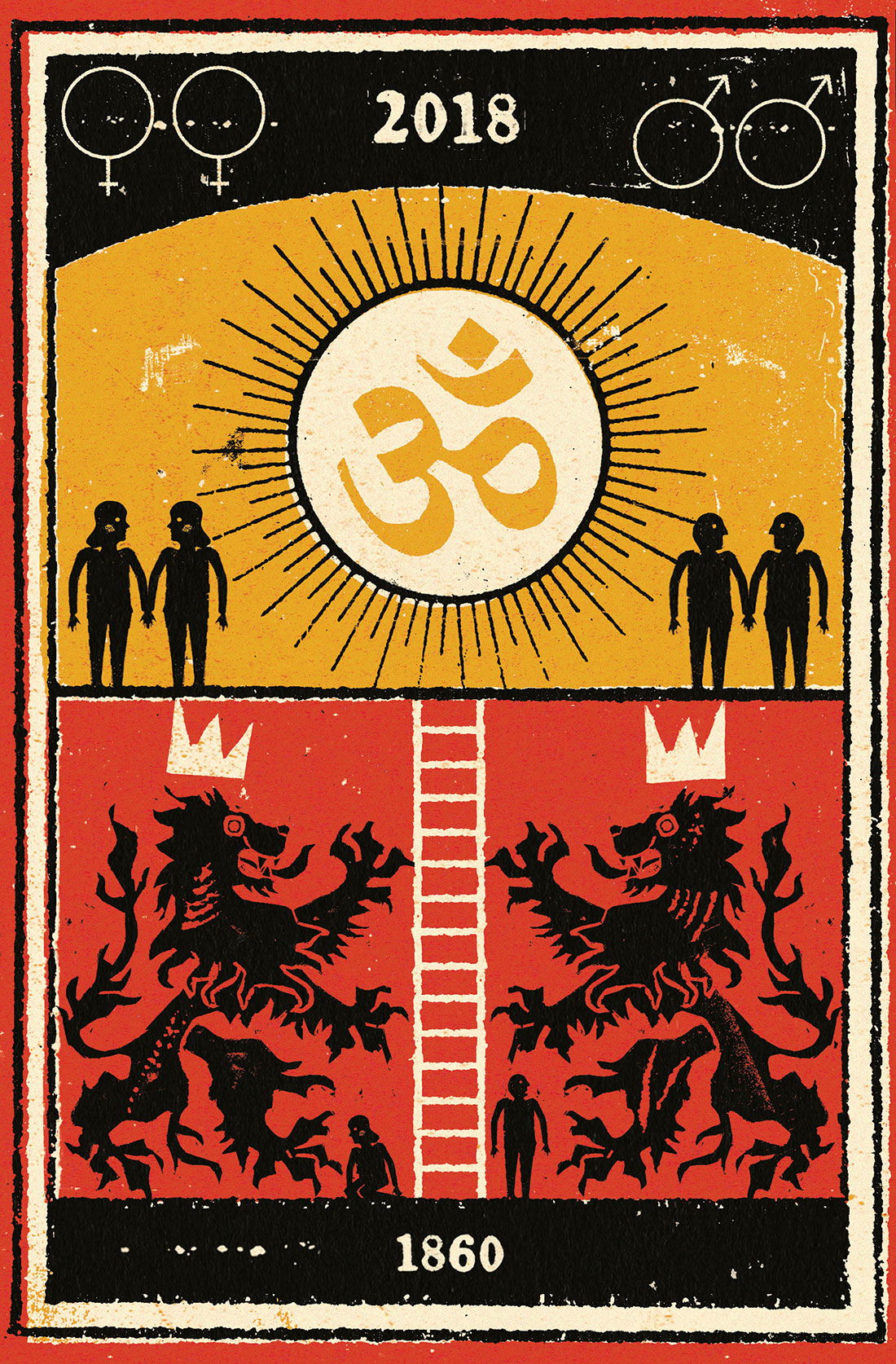
Illustration by Ben Jones.Illustration by Ben Jones.On 6 September 2018, India, the world’s largest democracy, finally decriminalised homosexuality. This historic judgment was passed after years of courtroom battles, long and arduous campaigns and protests, organised by millions of citizens, organisations and activists. The moment was widely celebrated.
For the first time, Indian citizens who identify as part of the LGBT community ceased to be outlawed. Initial reactions in the media reflected the populist idea that India had finally managed to break free of the shackles of colonialism. Within the first Indian Penal Code (1860), which came into force in January 1862, was Section 377, on ‘Unnatural Offences’. Based on the English Buggery Act (1533), it stated: ‘Whoever has carnal intercourse against the order of nature with any man, woman or animal shall be punished with imprisonment for life, or … for a term which may extend to ten years, and shall also be liable to fine.’
‘History owes an apology to those who have been persecuted and socially ostracised because of Section 377’, noted Indu Malhotra, one of the five judges delivering the verdict in September. The partial repeal (rape will, of course, continue to be an offence, as will carnal intercourse with children and bestiality) was, however, only obtained after a prolonged and arduous battle against prejudice, illiteracy and the indifference of Indian lawmakers of all parties. In the years since India’s independence, no policymakers have endeavoured to remove the law, despite the fact that it violated the fundamental right to equality, upheld by the Constitution, effected in January 1950: ‘The state shall not deny to any person equality before the law [on grounds] of religion, race, caste, sex, place of birth ...’

Ancient precedents

It is easy to understand why the decriminalisation of homosexuality might be seen as a return to India’s pre-colonial values. There are countless references to homosexuality and third-gender (those who are neither ‘male’ or ‘female’, either biologically or in presentation) in ancient Indian texts and epics. The Sanskrit epic the Mahabharata includes the tale of Shikhandi, born female, who later becomes male, though a eunuch. In the Ramayana (which, with the Mahabharata, forms the Hindu Mahakavyas, ‘epics’), describes Hanuman witnessing women kissing and also King Bhagirath’s birth from the union of two women. Ancient medical texts, such as Charaka Samhita, explain the reasons for different sexual behaviours and genders. Perhaps the most familiar Hindu depiction of third-gender is embodied by Ardhanarishvara, the androgynous form of the male Shiva and female Parvati, split down the middle equally, in which form Shiva pursues Vishnu – who has taken the form of a female enchantress.
These ancient texts were written when the region now known as India was under the sacrificial religion Brahmanism, essentially created by the upper caste (the priests) in the Vedic and post-Vedic periods (c.1500-500 BC). Hinduism, derived from Brahmanism, generally accepted the third-gender as natural. From the 12th century onwards, Muslim conquests failed to impact the entire Indian subcontinent and many regions continued to follow their traditional beliefs. Homosexuality was not frowned upon among the ruling classes – Muslim rulers such as Alauddin Khalji allegedly had male harems – although it was not as common among the people.

Who’s to blame?

The law criminalising homosexuality found itself a place in the Indian Penal Code (IPC) under the pretext of protecting family values and morality. Even though instances of convictions for homosexuality have been rare – with perhaps only 120-170 cases in the last 150 years – as a result of the law, gay and lesbian people have had to live as second-class citizens, facing harassment and prejudice, as ‘unconvicted felons’. This attitude has systematically driven sexual minorities, especially transgender people, to the fringes of society. Post-independence, India, with its apparent secular but Hindu-aligned ideologies, has striven to accuse either its colonial past or former Muslim rulers of actively stigmatising homosexuality, transforming it into something ‘unnatural’. Despite this, there has been little desire to change these attitudes and negligible public dialogue on the subject. Gay people remained largely invisible in the eyes of both the law and government. Only in the late 20th century, with the establishment of several gay rights organisations, did homosexuality start to be widely discussed and debated. India began to acknowledge the existence of gays only after sexual health became a matter of concern for the Indian government in the late 1980s.
The Stonewall riots of 1969 mark the origin of the modern gay rights movement in the US. India witnessed its first such protest in 1991 with the publication of Less than Gay, which described itself as a ‘A citizens’ report on the status of homosexuality in India’. It was prepared by seven members of the group AIDS Bhedbhav Virodhi Andolan (AIDS Anti-Discrimination Movement, or ABVA). The group began with 14 members, including doctors, lawyers and activists, who had been associated with social welfare activities in India for decades. They became the first organised group in India to work for people affected by HIV. They also started to work towards legalising homosexuality, filing a petition in 1994 challenging the legality of Section 377. The ABVA and its activities reached many people, bolstered by the Naz Foundation, an NGO dedicated to working on issues such as HIV/AIDS, as well as smaller LGBT groups, which came together, mobilising people for gay rights. The success of the movement does not, however, veil the fact that, since independence, India has continued to support and bolster Section 377.

Homophobic politicians

Two historians of gender and sexuality, Ruth Vanita and Saleem Kidwai, in their book, Same-Sex Love in India: Readings from Literature (2000), called not just for the decriminalisation of homosexuals, but ‘full and complete acceptance, not tolerance and not sympathy’. Only that, they argued, would enable homosexuals to emerge from the shadows and lead a dignified life. For this to happen, it is imperative for India to acknowledge its social conservatism – the result of caste, class and religious discrimination, Western influence and a low rate of literacy – rather than simply blaming the colonial past for taking such a long time to repeal this law.
The sovereign Republic of India took nearly 70 years to guarantee a fundamental right to a huge percentage of its citizens. In 2015, India was one of 43 countries that voted – unsuccessfully – against equal benefits for same-sex partners working at the United Nations. Anjali Gopalan, director of the Naz Foundation, who filed the Public Interest Litigation against Section 377 in 2001, said: ‘This shows how homophobic the politicians in our country are.’ Across political parties, ministers and political leaders either dodged questions on gay rights or referred to homosexuality as unnatural and undesirable.

Victorious dissenters

The first sign of change was seen in July 2009, with a verdict delivered by the Delhi High Court, which decriminalised homosexuality among consenting adults. The decision, while extolled, also faced significant stricture. In 2012, the Supreme Court of India overturned the decision, saying that a ‘minuscule fraction of the country’s population constitute LGBT community’, and left it for Parliament to decide. In 2016, five petitions were filed in the Supreme Court, which argued that ‘rights to sexuality, sexual autonomy, choice of sexual partner, life, privacy, dignity and equality, along with the other fundamental rights … are violated by Section 377’. In August 2017, the Supreme Court declared that the right to privacy should be considered a fundamental right. Following this, the verdict of 6 September 2018 finally bore fruit.
The repeal of Section 377 can be attributed to the show of dissent by the Indian people. The popular sentiment in India, at least in the urban sphere, for the past two years was against 377, mainly because of the work of activists in garnering support across the country and across religions. From a handful of people in the first protest in the early 1990s, thousands took to the streets to celebrate the verdict in 2018. The repeal cannot, however, be seen as a long-awaited ‘casting off’ of the vestiges of colonial law and attitudes. The attitudes against which India’s LGBT activists have had to fight were perpetuated and entrenched at all levels of Indian society long after independence. To blame only colonialism is to absolve independent India of any responsibility for the treatment of its citizens. Now that the law gives them equality, will society follow suit?
Arnab Chakraborty is a PhD candidate at the University of York.
This article has been reproduced from History Today for educational and non-commercial purposes. See the link below for original article:

Wednesday, 28 November 2018

An Open Letter To Indian Parliamentarians To Get Section 377, IPC Repealed In Toto


by
Dr. P. S. Sahni

By now you must have perused the judgement of the Supreme Court of India which has partially struck down Section 377, Indian Penal Code (IPC) which hitherto criminalized any sexual act against the order of nature. The judgement was delivered on September 6, 2018.
To recapitulate, the Indian Government had informed the Supreme Court that it leaves it to the wisdom of the Court to decide the issue. Actually the entire ruling class parties abdicated their responsibility of addressing the issue through Parliament – which alone, and not the judiciary, represents the will of 1.35 billion people of India.

The slick high profile lawyers, counsels who appeared in the court and the extravagantly foreign funded NGOs[i] buckled under judicial pressure without even a whimper of protest in toning down the original demand of complete repeal of Section 377, IPC as demanded by ABVA in the first ever challenge to the constitutional validity of Section 377, IPC way back in 1994 in the case filed before the Delhi High Court:
AIDS Bhedbhav Virodhi Andolan vs. Union of India & others.
The case was filed by ABVA through its member and advocate Shobha Aggarwal.

On the recent Supreme Court judgement we urge you to immediately bring – as a first step – an Ordinance ordaining that the whole of Section 377, IPC stands repealed. The speed with which the Ordinance should be brought must match the speed with which the Ordinance on triple talaq has been surreptitiously introduced. Media reports in the last 4 weeks indicate that several same-sex couples are approaching High Courts of different states for relief and security in being allowed to stay together. They should not be forced to go through this ordeal just close on the heels of the Supreme Court judgement of 6 September, 2018.
The piecemeal relief provided by the Supreme Court to LGBTQI community will certainly not alone resolve the long standing demands made by ABVA in 1991 – and towards which successive Central Governments of all hues have indulged in masterly inactivity.

We quote from one of the most respected LGBTQI activists and academician Ashley Tellis – the conscience keeper of sexual minorities – who has suffered all his life on account of being open about his sexuality; the frequent loss of jobs is but one aspect of his being at the receiving end of the establishment:

"It just renders privacy rights to elite gay people. I've made this point again and again. Nobody wants to listen because of the mindless hysteria around the subject."
"Privacy in this context is a classist idea. Only people who have a bedroom can have privacy. Hijras on the road who are often forced to have public sex for money to survive don't have this privacy. They are harassed by the police, their clients and the societies around them. This doesn't change anything for them and the rest of the LGBTQ community on the ground. People have bedrooms and privacy everywhere. They don't need a special law to change that. This is something those who are privileged exercise anyway. I don't think there will be any actual change on the ground."[ii]

The Supreme Court judgement refers to studies quoted by petitioners indicating the LGBTQI population to be about 7 to 8%. Now in a country of 1.35 billion people it translates to a population of 100 million people belonging to the sexual minorities. The youth constitutes 60% of this population. About time the political parties should appreciate that a population of 100 million people constitutes the second largest minority community in India next only to the Muslim community; and that the sexual minority community can influence, nay change the contours of government formation – both at the Centre and state level in future, nay as early as 2019. Future ministers in Indian Government could well include a Christian Lesbian; Muslim Gay; Sikh Queer; Tribal of Mongoloid race (from the North Eastern States of India); Transgender; Dalit (of Dravidian stock) Bisexual. This political formation could be the best bet for a secular, democratic regime. The political interests of the working class (workers, farmers) would need to be assured. The Pride marches undertaken by the LGBTQI persons from time-to-time could evolve after a long, long haul into a Self-Respect Movement. The transgender community (eunuchs) have led the way for the rest of the sexual minorities group; they have been in electoral politics for over two decades and several of them have won elections to become Mayors in towns/cities in India.

We reiterate the updated Charter of Demands for your kind consideration and positive action:
1.      Repeal Section 377 of the Indian Penal Code in full, instead of in part as done by Supreme Court judgement dated 6 September, 2018 in Navtej Singh Johar vs. Union of India; the relevant sections of the Army, Navy and Air Force Acts, 1950 should also be repealed in full.
2.      Enact civil rights legislation to offer LGBTQI citizens the same protections now guaranteed to others on the basis of caste, creed, and colour.
3.      Reform police policy (for example, by calling a meeting of senior police officers, including all Station House officers (SHOs)), to put an end to the harassment of gay people at the hands of the police and public. Police authorities should take the initiative to make available information on all local public nuisance laws used on gay people in public places, and the relevant procedures and penalties specified therein. They should also make public the numbers of arrests, prosecutions and convictions of gay people under various laws along with the period of sentence, amount of fine and age of the offenders.
4.      Establish a Commission to document human rights violations of gay people, such as violence and blackmail directed at gay men and lesbians, as well as atrocities within marriage on lesbians who may be married to men.
5.      Redefine the offence of rape in the Indian Penal Code to include all coercive sexual acts rather than only vaginal penetration. Rape laws should be made applicable to both men and women, irrespective of whether they are gay, non-gay, married or single.
6.      Have the Press Council of India issue guidelines for respectful, sensitive and representative reporting on gay men and lesbians and issues around homosexuality.
7.      Have the Medical Council of India (MCI) issue guidelines to the effect that refusal to treat a person on the basis of his/her sexual orientation is a cause for censure on grounds of professional misconduct. Bring medical curricula in schools and medical colleges in line with the latest scientific theories of homosexuality.
8.      Consider unethical any reckless and uncalled for sex-change surgery without informed consent and counselling. Counselling should be made available to help a person deal with the normality of his/her gender incongruities. Any irresponsible experimentation by medical professionals in this area should be made punishable by law.
9.      Institute a massive, nation-wide survey of sexual behaviour in our society.
10.     Ensure that everyone receives judgement-free health education related to sexuality, homosexuality, Sexually transmitted Diseases (STDs), HIV testing, AIDS and condom use. All AIDS-related education should explicitly acknowledge sexual interaction between people of the same sex.
11.     Make available anonymous HIV testing facilities for all.
12.     Alter the heterosexist bias in education, from school onwards, by presenting positive images and role models of gay man and lesbians and of homosexuality as a viable, healthy alternative lifestyle.
13.     Amend the Special Marriages Act to allow for marriages between people of the same sex (or between people who may be inter-sexed, or have undergone sex-change surgery, and any others) making marriages as legal when solemnized in the presence of friends, relatives or any other person by exchanging garlands or rings or by a declaration in a language understood by both parties that they accept each other to be their spouse.[iii] All consequential legal benefits of marriage should extend to gay marriages as well, including the right to adopt children, to execute a partner’s will, etc. Same-sex couples should also be entitled to the legal benefits that accrue to their heterosexual counterparts of common law marriages. No presumption as to fitness or unfitness for custody of a child or visitation rights shall arise based on sexual orientation of either parent in such a situation. In case marriages among members of sexual minorities group are to be undertaken in a temple, the facility of a non-Brahmin priest duly trained at a Government centre should be provided.[iv]
14.  Alternatively, legally recognize and encourage friendship agreements between single people of the same-sex as a valid way of organizing family life.
Dr. P.S. Sahni
Member, AIDS Bhedbhav Virodhi Andolan
Email: aidsbhedbhavvirodhiandolan@gmail.com


[i] It may be recalled that both Lawyers Collective and Naz Foundation, India’s representatives had been hobnobbing with the Indian Government (NACO, Health Ministry etc.) over AIDS and related issues. Both receive massive foreign funds. The head of one of these NGOs has been bestowed an award by the Indian Government; in fact in 2001 the demand for repeal of Section 377, IPC had been toned down by NAZ even in its prayer before the Delhi High  Court.
[iii] Tamil Nadu legalized the concept of Self Respect Marriages advocated by Periyar E.V. Ramasamy, devoid of Brahminical priests and rituals through an exclusive enactment in 1968!
[iv] In December 2015, the Supreme Court of India gave a verdict which allowed the appointment of duly trained priests from any caste.


Also at: 1. https://countercurrents.org/2018/10/06/an-open-letter-to-indian-parliamentarians-to-get-section-377-ipc-repealed-in-toto/
2. http://www.kashmirtimes.com/newsdet.aspx?q=83587
3. http://www.gaylaxymag.com/blogs/an-open-letter-to-indian-parliamentarians-to-get-section-377-ipc-repeal-in-toto/#gs.EarC5BE

Thursday, 15 November 2018

Was 1992 a Turning Point for Homosexuals in Contemporary India?

Was 1992 a Turning Point for Homosexuals in Contemporary India?

  • Nicholas Tan
  1. 1.
  2. 2.
Original Paper
  • 32Downloads

Abstract

For many familiar with contemporary India’s history of homosexuality, 1992 may be seen as a turning point. In 1992, activists protested against the infamous anti-sodomy law, Section 377 of the penal code, a provision which had been frequently employed by the police to harass the gay community. The public protest marked a historical point in the lives of the Indian homosexuals as the issue of homosexual citizenry entered public and popular discourse in contemporary Indian society. This paper seeks to establish the validity of 1992 as a historical point beyond the singular event of protest. It attempts to encourage one to consider the ways in which the increased political subjectivity of the homosexuals in contemporary India intersect with the historical emergence of the Hindu Right’s ideological hegemony from the 1990s. The added lens helps one to seek how the political and the personal can come together to identify, and invite discussion on, the varying statuses of different homosexual groups, ranging from lesbians to Muslim homosexuals, both of which tended to be marginally excluded from the emergence of a collective homosexual identity in the movement against Section 377.

Wednesday, 26 September 2018

Press Release: ABVA releases digitized version of its report “Hard Times For Positive Travel”


On ‘World Tourism Day’ AIDS Bhedbhav Virodhi Andolan (ABVA) is releasing the digitized version of its report “Hard Times For Positive Travel” which originally appeared as a hard copy in September, 1993 at New Delhi, India. The document is a Citizens’ Report on the status of travellers with HIV/AIDS. It was prepared by nine ABVA members. The trigger point for this documentation was the inhuman and cruel treatment meted out to a French tourist visiting Calcutta (now Kolkata) who was deported from India on account of being HIV positive. As per media reports:

“In February 1992, a French tourist visiting Calcutta fell ill. She was taken by a colleague tourist to a private nursing home of Calcutta. At the nursing home the tourist informed the doctors that she is HIV positive. This set a chain reaction of panic. Instead of taking basic precautions for infection control, the health professionals only displayed the level of their ignorance which was evident from the sequence of events that followed. The patient, who had dehydration was shifted to another nursing home and subsequently deported from the country.”

At that time ABVA was concerned about the harassment and hounding out of HIV positive foreigners by the Indian Government, as also by governments all over the world. Foreign travellers everywhere were being targeted as high risk group which could spread HIV infection amongst the people of the country being visited. This was a monumental hoax perpetrated by the medical establishment. The irrational fear amongst the allopathic doctors was the only reason for the discrimination faced by HIV positive travellers – who were being forcibly tested, quarantined and deported back to their country of origin. Not a word of regret was being offered by the local governments. Foreign students found to be HIV positive were being sent back to their country of origin. This happened even at the prestigious Jawaharlal Nehru University, New Delhi. Even the most advanced countries including USA resorted to deportation of HIV positive persons. An International AIDS Conference which was to be held in Boston was moved to Amsterdam in protest against US curbs on the movement of people carrying HIV infection.

While preparing the report ABVA sent letters to embassies and high-commissions of ninety-three countries to explain their immigration and visiting laws with respect to people with HIV/AIDS. Only seven of them chose to respond viz Austria, Brazil, France, Germany, Jordan, Poland and Switzerland. These few countries had an overtly progressive position, while a number of those who practiced discriminatory policies remained silent.

A ten point Charter of Demands was presented by ABVA (see Report) to the Indian Government to have a scientifically oriented, humane solution in the context of HIV positive travellers to India. ABVA even petitioned the United Nations to take necessary steps so that member states of the U.N. bring a halt to the discrimination faced by HIV positive persons/ AIDS patients in the context of travel from one member country to another.

25 years after the ABVA’s report was released, 35 countries out of 193 countries (WHO list) still have HIV related travel restrictions.

India reportedly lifted all travel restrictions against HIV positive patients in 2010.


Shobha Aggarwal
ABVA member

Sunday, 23 September 2018

A BRIEF HISTORY OF THE GAY RIGHTS MOVEMENT IN INDIA by Sanjukta Bose


A Brief History Of The Gay Rights Movement In India


6 September 2018 shall be ceaselessly celebrated because the day India moved on to the suitable aspect of historical past and stood up for the rights and dignity of a group that had suffered by the hands of the federal government and the whole society because the days of colonialism. The scraping of Part 377 arrived at a time when LGBTQ activism is at its peak in India, however so is the violence and discrimination towards the group. The historic verdict is being hailed as a a lot wanted step ahead within the battle to finish all types of discrimination based mostly on one’s sexual orientation. Nevertheless, this victory is the results of almost three many years of steady onerous work and devoted activism by people and organizations who pledged their complete lives to this trigger. Most of it, sadly, stays unknown and finds no place within the annals of India’s trendy historical past. Lack of understanding and consciousness is all the time cited as a key issue that contributes to rampant homophobia among the many plenty, permits highly effective establishments to get away with distortion of information and knowledge that additional fuels the issue.
Even earlier than Naz Basis and the Legal professionals Collective filed a PIL for the repeal of Part 377 in 2001, there have been organizations and activists who had been preventing for the homosexual rights motion in India. In 1977, Shakuntala Devi revealed “The World of Homosexuals” which is claimed to be the primary research of homosexuality in India, towards the backdrop of the Emergency years. Right here, she burdened that the necessity of the hour was to acknowledge the existence of and create inclusive areas for the gay inhabitants of the nation. In 1981, the All India Hijra Convention was held in Agra and noticed participation from almost 50,000 members of the group. In 1999, the primary ever satisfaction parade in India passed off in Calcutta on July 2nd. It was referred to as the Friendship Stroll and hardly had fifteen individuals.
The first organized public protest of the homosexual rights motion in India was held on 11th August, 1992 outdoors the Police Headquarters at New Delhi. It was organized by the AIDS Bhedbhav Virodhi Andolan (or the AIDS Anti Discrimination Movement) and was attended by over 500 enthusiastic people, together with civil liberties and democratic rights teams. The protest was organized a day after 18 individuals have been arrested from the Central Park, Connaught Place on costs that they have been allegedly about to interact in gay acts. When members of ABVA approached cops to investigate concerning the arrest, they have been advised that that they had acquired complaints from residents within the neighboring areas relating to the “menace of homosexuals” within the park through the night hours. Harassment of this type continues to be a standard apply in several elements of India even as we speak. In June this yr, a homosexual man and his pal have been crushed up by police in Delhi and subsequently arrested for hugging a trans lady. Nevertheless, with the partial striking- down of Part 377, members of the group a minimum of have authorized safety now that may assist them search redress.
The ABVA began out in 1988-1989 as a non-profit group that labored to finish all types of discrimination towards HIV/AIDS in India. Throughout its preliminary days, it comprised an eclectic mixture of members that included a leprosy affected person, a nun, a closeted homosexual individual, social staff, docs, legal professionals, non-formal schooling staff, ladies’s teams’ members and even a pavement dweller. In 1989, ABVA performed a big position in stalling the AIDS Prevention Invoice, 1989 from passing, by means of petitions within the Parliament, public conferences and protest. Had this draconian invoice been handed, then excessive danger teams can be forcibly examined for HIV by the federal government and people with constructive outcomes can be pressured into quarantine. This regulation would have massively violated the civil and democratic liberties of many.
The group is credited with publishing the primary citizen’s report on the state of homosexuals in India titled “Less Than Gay”. The report was ready by seven ABVA members, viz Arun Bhandari, Dr. J.P. Jain, Jagdish Bhardwaje, Lalitha S.A., Dr. P.S. Sahni, Shalini S.C.N. and Siddharth Gautam. The report additionally carried the Constitution of Calls for- the LGBTQ Manifesto that, for the primary time in India, articulated the demand for the repeal of Part 377 together with the related sections of the Military, Navy and Air Drive Act, 1950 that criminalized same- intercourse sexual actions. It demanded for the popularity of proper to privateness as a elementary proper for all residents of the nation. The manifesto additionally burdened on the necessity for equal civil rights and authorized protections of the LGBTQ group and in addition demanded the institution of a authorities fee to doc human rights violations of queer people in India.
In 1994, ABVA filed the primary Public Curiosity Litigation (PIL) in Delhi Excessive Courtroom difficult the constitutional validity of Part 377- this was the primary authorized protest towards the oppression of the LGBTQ group in India by authorities establishments and set the ball rolling for the homosexual rights motion in India. No queer individual volunteered to be part of the case regardless of greatest efforts made by the group. Again then; even individuals belonging to the LGBTQ group have been reluctant to brazenly help and struggle for the group for worry of public backlash and repercussions. Keep in mind, that within the 1990s, it was a lot more durable to be queer in India than it’s at the moment. The petition was dismissed in 2001, nevertheless it sowed the seeds for a battle that went on for years till it lastly noticed the glimmering mild of success. The PIL was truly filed because of a public controversy whereby ABVA activists have been refused permission by authorities of Tihar Jail once they needed to distribute condoms to the prisoners. Kiran Bedi, the then Inspector Common of Prisons, refused permission on the grounds that permitting distribution of condoms would imply admitting the existence of gay relations in Tihar and that it will encourage the follow additional.
Alongside ABVA, Humsafar Belief was one other NGO that pioneered the reason for LGBT rights in India. Its preliminary focus was on offering HIV/AIDS well being providers to homosexual males, however quickly it expanded to offer steerage, checkups, counseling and outreach for the whole LGBTQ group. The founding father of this group, Ashok Row Kavi, is claimed to have written the primary “coming out” story in India that was revealed in 1986 in Savvy journal. At the moment, Kavi didn’t understand the influence his story would have on his personal life and on the lives of different individuals. In an interview afterward, Kavi admitted he had no concept that his story would trigger such controversy. “When you come out in India, [your] gay identity becomes your primary identity… All the other identities- being a good journalist, for instance- become backups. When I came out in 1984, I didn’t realize it would create such a ruckus, but I nearly lost my job. My boss stood by me, though. Fortunately, I had come out to him before I had accepted the job,” Kavi had said.
2001 noticed sure landmark occasions within the wrestle for LGBTQ rights in India. Alongside the PIL filed by the Naz Basis and Legal professionals Collective, queer people in Mumbai staged a silent protest outdoors the well-known Flora Fountain, ushering in a brand new tradition of protest for the motion. The protest was in response to the arrests made in July 2001 by Lucknow Police. They arrested a gaggle of males from an area park on the grounds of suspected homosexuality. One among them was a employee with an NGO referred to as the Bharosa Belief; the police raided their workplace and confiscated safe- intercourse aids, like condoms, lubricants, educational movies and dildos. This information was reported with a lot sensationalism by the mainstream media, since journalism round homosexual rights then was severely uninformed and had a bent for sensationalizing incidents surrounding this problem.
The lengthy wrestle of LGBTQ activism in India is one that’s peppered with each victories and losses. In 1987, the wedding of Leela and Urmila, two policewomen from Madhya Pradesh, turned the primary recognized case of similar intercourse marriage in India. The two of them ultimately misplaced their jobs. In 2002, Kali turned the primary hijra individual to face for elections in Bihar and was elected a ward councilor. In 2004, Pushkin Chandra and his companion Kuldeep Singh have been each murdered in chilly blood. This incident delivered to mild the homophobic violence within the nation and it was solely in 2010 that the murderers have been awarded life sentences. In 2010, the Delhi Excessive Courtroom handed a landmark judgment granting equal rights to “sexual minorities”. The Supreme Courtroom in 2013 overturned this judgment, stating that issues pertaining to the repealing or amending of Part 377 must be left to the Parliament, not the judiciary. In January 2018, the Supreme Courtroom agreed to listen to a petition to revisit the 2013 Naz Basis judgment.
What this lesson in historical past teaches us is that the struggle isn’t actually over. There’s nonetheless a lot work left to be executed. A number of legal professionals, activists, NGOs and people spent their lives struggling in order that we might stay in a greater world; and our obligation in the direction of them is to create extra accepting and protected areas for many who come after us. We should educate ourselves and people round us, unfold consciousness towards homophobia, maintain establishments of energy accountable for his or her insurance policies and actions, help and shield those that want it probably the most, and promise to not get complacent on this current victory.
Featured picture supply: Instagram 
Abstract
Article Identify
A Brief History Of The Gay Rights Movement In India
Writer
Sanjukta Bose
Description
This is every thing you want to know concerning the Gay Rights Movement in India. Let there be delight with out prejudice!
Courtesy: Herald Magazine. link: https://visprfashions.com/a-brief-history-of-the-gay-rights-movement-in-india/
This article has been reproduced for educational and non-commercial purposes.